PIPEDA & Voice Recording Retention in Accessibility Products: A Playbook
For accessibility product developers, PIPEDA's limits on data retention present a critical challenge: knowing precisely when to delete voice recordings. Canada's PIPEDA law dictates that voice data must only be retained as long as necessary for its original purpose.
What PIPEDA Means for Voice Recording Retention in Accessibility Products
While many privacy discussions focus on data collection, the less obvious but equally critical challenge for accessibility product developers under PIPEDA is the limit on data retention: knowing precisely when to delete voice recordings. Canada's federal private-sector privacy law, the Personal Information Protection and Electronic Documents Act (PIPEDA), which has been in effect since 2001, dictates that organizations must retain personal information only as long as necessary to fulfill the specific purposes for which it was collected. For voice-enabled assistive technologies, this means every recorded command, dictation, or biometric sample must have a justifiable retention period tied to its explicit purpose, rather than being stored indefinitely.
Voice recordings from accessibility products are unequivocally considered ‘personal information’ under PIPEDA, particularly if they can be identified with an individual or linked to a disability profile. This classification triggers a full spectrum of obligations for developers, from obtaining meaningful consent to implementing robust security measures. The unique challenge within the accessibility sector lies in the inherent sensitivity of disability-related data and the critical role continuous voice interaction plays in product functionality. A voice-activated wheelchair, for instance, requires processing voice commands for immediate action, but retaining those specific command recordings long-term may not always align with the ‘necessity’ principle.
Therefore, what PIPEDA means for voice recording retention in accessibility products is a mandate for precision and purpose-limitation. Developers cannot simply ‘hoard’ data “just in case.” They must articulate clear, defensible reasons for retaining each type of voice data, establish explicit retention schedules, and ensure secure deletion protocols are in place once the stated purpose is fulfilled. This directly impacts how a Canadian developer designs features for a dictation app or a voice interface for a screen reader, requiring a proactive, privacy-by-design approach to data lifecycle management.
Understanding PIPEDA: The Basics of Canadian Privacy Law for Organizations
Navigating the legal landscape of data privacy is a non-negotiable for accessibility product developers in Canada, yet the granular application of federal privacy law to voice data often gets overlooked. The Personal Information Protection and Electronic Documents Act (PIPEDA), in force since 2001, governs how private-sector organizations handle personal information during commercial activities across Canada. This includes any organization collecting, using, or disclosing voice recordings, which, if identifiable, fall squarely under PIPEDA’s definition of personal information.
PIPEDA is built upon ten Fair Information Principles, setting the foundational expectations for privacy management. These principles include accountability for personal information, identifying the purposes for collection, obtaining meaningful consent, and limiting the collection, use, disclosure, and retention of data. For a voice-enabled accessibility product, this means clearly articulating why a user’s voice is recorded, how it will be used, and for how long. A voice assistant designed to help a disabled person navigate their smart home, for example, must be transparent about its data practices from the outset.
Understanding these core tenets is crucial for any accessibility product developer to build privacy-compliant voice-enabled technologies. This foundational knowledge directly impacts what PIPEDA means for voice recording retention in accessibility products, guiding developers toward responsible data practices that respect user rights while fostering innovation.
What Constitutes 'Personal Information' in Voice Recordings from Accessibility Products?
What Constitutes 'Personal Information' in Voice Recordings from Accessibility Products?
Many accessibility product developers mistakenly assume that only overtly identifiable data like names or addresses fall under PIPEDA. However, voice recordings, particularly within assistive technologies, are almost always considered 'personal information' under the Personal Information Protection and Electronic Documents Act (PIPEDA), especially when linked to an individual or their usage patterns. This broad interpretation is critical for understanding what PIPEDA means for voice recording retention in accessibility products.
This classification extends beyond simple identifiers. Raw audio, for instance, can contain unique vocal characteristics that, with modern analysis, could identify an individual. Voiceprints used for biometric authentication, common in secure access features for disabled users, are inherently personal. Even transcribed text, if it reveals sensitive details about a user's disability, health status, or personal life, falls under PIPEDA's scope. Consider a dictation tool used by a user with limited mobility; continuous speech input often captures highly personal and sensitive information that demands stringent privacy protection.
The sensitive nature of disability-related data, frequently conveyed through voice interaction with assistive technology, necessitates an elevated standard of protection. The Office of the Privacy Commissioner of Canada (OPC) consistently emphasizes that information revealing a disability often warrants a higher degree of protection due to its potential for discrimination or harm.
A crucial distinction lies between types of voice data. A single, anonymous voice command like "volume up," disconnected from any user profile, carries less privacy risk. Conversely, continuous dictation for document creation or diagnostic voice samples collected for speech therapy applications contain a wealth of personal detail. Developers must assess each data type based on its potential to identify an individual or reveal sensitive information.
The table below illustrates how different types of voice data commonly found in accessibility products are typically classified under PIPEDA, along with examples.
Voice Data Type
PIPEDA Classification
Example in Accessibility Tech
Raw Audio (Identifiable)
Personal Information
A user's recorded dictation for document creation using a screen reader.
Voiceprint (Biometric)
Highly Sensitive Personal Information
Voice authentication for accessing a specialized communication app.
Transcribed Text (Sensitive Content)
Personal Information
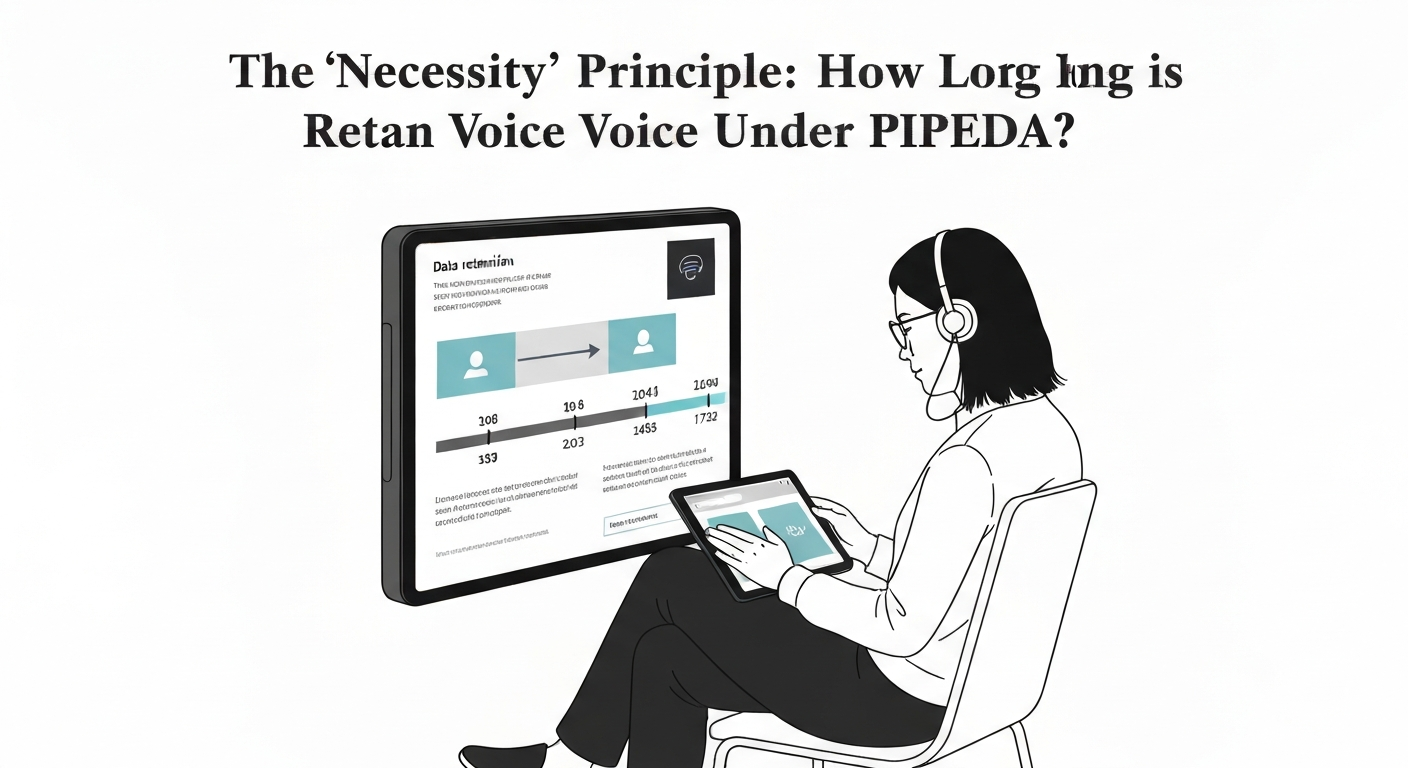
The 'Necessity' Principle: How Long is Too Long to Retain Voice Data Under PIPEDA?
Indefinite retention of voice recordings, even for laudable accessibility goals, directly conflicts with PIPEDA's foundational 'necessity' principle. Organizations must only keep personal information for as long as required to fulfill the specific purposes for which it was collected. This means accessibility product developers cannot simply store all voice data indefinitely for future, undefined improvements; a clear, time-limited justification is mandatory. For instance, a voice assistant designed to help disabled people navigate smart home devices might retain short command snippets for 30 days to refine its natural language processing (NLP) model for that specific user, but not store full conversations.
The core challenge for voice-enabled accessibility products lies in balancing the continuous need for model refinement and user personalization against the imperative to purge data once its stated purpose is met. A developer building a voice-to-text tool for students with motor impairments in Ontario, for example, must precisely define if retaining dictation for six months is truly necessary for accuracy improvements, or if a shorter period, like 90 days, would suffice. The Office of the Privacy Commissioner of Canada (OPC) consistently emphasizes that "necessary" implies a reasonable, proportional link to the identified purpose, not merely a convenient one.
what PIPEDA means for voice recording retention in accessibility products. While direct financial penalties might seem substantial, the reputational damage and loss of user trust from a privacy breach can be far more costly for an accessibility tech company. Any retention period should instead depend on the specific function of the voice data in an accessibility product.
Obtaining Meaningful Consent for Voice Recording in Accessibility Products: Best Practices
Securing meaningful consent for voice data collection in accessibility products moves beyond boilerplate privacy policies. Under PIPEDA, individuals must genuinely understand *what* personal information, including voice recordings, is collected, *why* it's needed, and *who* might access it, before providing agreement. For a user of a voice-enabled accessibility app, such as a dictation tool, this means understanding that their speech is processed to convert it to text, and whether that speech data leaves their device. Accessibility product developers must ensure consent mechanisms are not only legally sound but also practically usable for disabled people, including people with cognitive, visual, or hearing disabilities.
Generic "I agree to the terms" checkboxes fail to meet this standard, especially when dealing with sensitive voice data. Instead, developers should offer granular consent options. A user of a voice control system, for example, might consent to their spoken commands being used for device control but opt out of their dictation being analyzed for language model improvements. This approach respects user autonomy and aligns with the Office of the Privacy Commissioner of Canada's guidance on meaningful consent, which emphasizes clarity and user control. Similarly, a teacher using a voice-to-text tool for students with fine motor challenges needs to be able to assure parents that only transcription occurs, not long-term storage or analysis of children's voices.
Implementing these practices helps developers clarify what PIPEDA means for voice recording retention in accessibility products and build trust. The next step involves understanding how long this consented voice data can actually be retained under the 'necessity' principle, aligning with the initially stated purpose.
Implementing Data Minimization and Secure Deletion Strategies for Voice Data
Effective data minimization and secure deletion are not optional; they are foundational to what PIPEDA means for voice recording retention in accessibility products.
1
Collect Only Necessary Data
Design accessibility tools to capture the absolute minimum voice data required for functionality. For instance, a dictation app should only record speech when actively invoked, not passively monitor background audio. Unnecessary data increases privacy risk without adding value.
2
Prioritize On-Device Processing
Whenever technically feasible, process voice data directly on the user's device. This significantly reduces the need to transmit sensitive raw audio to cloud servers, aligning with the "necessity" principle. For example, a dictation tool that converts speech to text on the device keeps the raw audio within the user's control.
3
Implement Immediate Deletion Post-Processing
For voice data sent to the cloud for transcription or command execution, ensure immediate deletion of the original audio file once its purpose is fulfilled. A voice assistant facilitating smart home control in a Canadian home should delete the raw audio of "turn off the lights" moments after the command is processed, retaining only the transcribed text if necessary for system improvement, and only with explicit consent.
4
Establish Clear Retention Schedules
Develop and strictly enforce documented retention periods for any voice data that must be stored. These schedules must align with the 'necessity' principle outlined in PIPEDA. For instance, diagnostic voice logs for a speech-to-text input method might be retained for a maximum of 30 days, anonymized, and then securely purged.
5
Utilize Secure Deletion Methods
Employ industry-standard secure deletion techniques, such as cryptographic erasure or multi-pass overwriting, to ensure voice data is permanently unrecoverable from all storage locations, cloud, local, and backups. Simply "deleting" a file often just removes its pointer, leaving data recoverable.
Balancing Accessibility Innovation with User Privacy: A Practical Framework
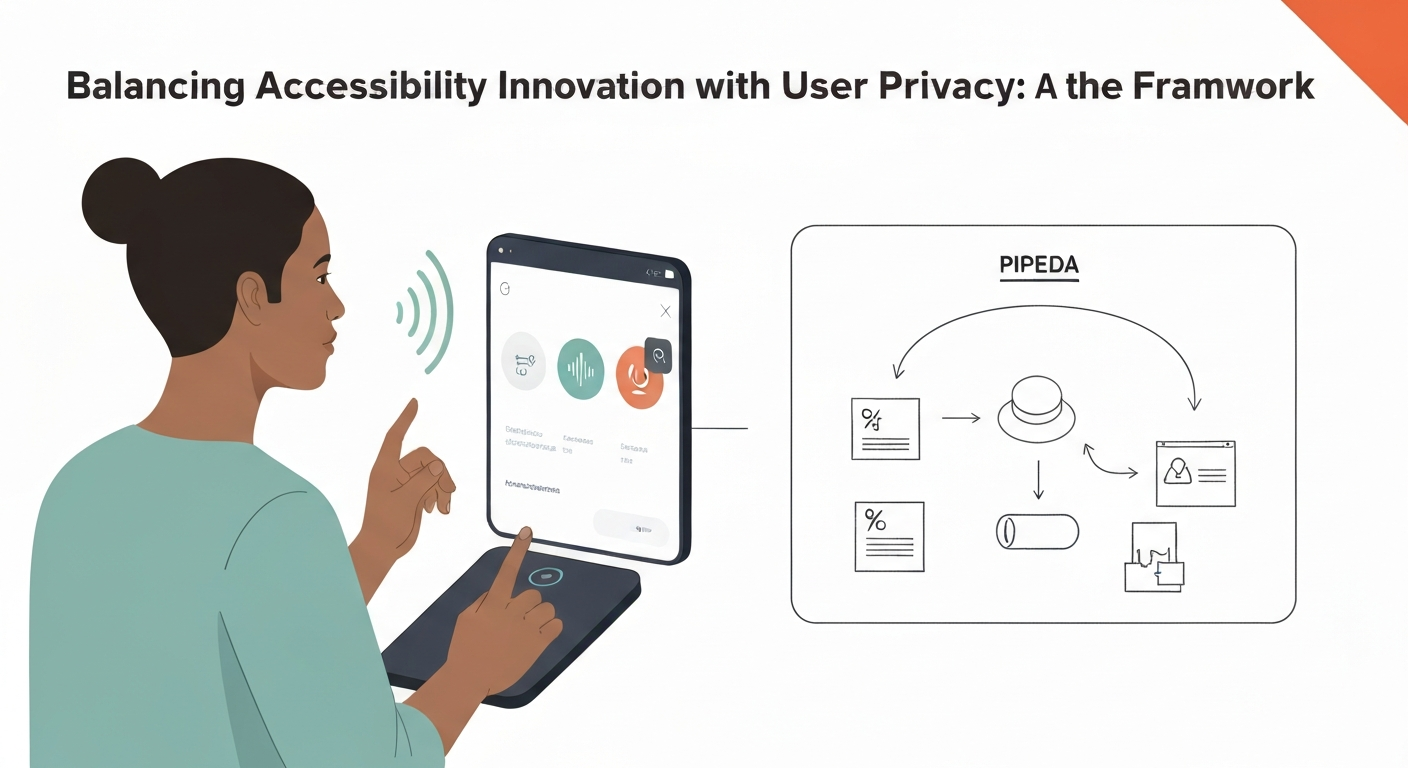
Balancing Accessibility Innovation with User Privacy: A Practical Framework
The core challenge for accessibility product developers is not merely avoiding PIPEDA violations, but proactively integrating privacy as a design principle, especially concerning voice data. Instead of seeing privacy as a compliance hurdle, developers must view it as a foundational element that enhances trust and utility for disabled people. For example, a teacher could use dictation software that transcribes student responses without retaining unnecessary voice profiles, so that sensitive developmental data remains private even as the tool improves its accuracy over time.
A "Privacy-by-Design" approach demands that privacy considerations are embedded from the initial concept phase of voice-enabled assistive technologies. This includes prioritizing user control and transparency, ensuring that individuals using a voice-first tool like a screen reader have clear visibility into what PIPEDA means for voice recording retention in accessibility products. They need robust, easily accessible controls over how their voice data is used, stored, and deleted. For instance, an individual using a voice assistant to control their smart home in Alberta should be able to specify that only command phrases are processed and immediately discarded, with no raw audio retained for model training, unless explicitly opted into via a clear, granular consent mechanism.
Developers should explore privacy-enhancing technologies (PETs) like federated learning or differential privacy. These methods allow voice recognition models to improve accuracy by learning from decentralized data sets without directly accessing or centralizing individual user voice data. This significantly reduces the privacy risk associated with retaining sensitive voice recordings. Engaging with disability communities and privacy experts during the design phase is also crucial. This collaborative approach ensures that solutions are both highly functional for disabled users and ethically sound, reflecting community-specific privacy expectations rather than just fulfilling minimum legal requirements.
This iterative framework requires continuous evaluation of new technologies and their privacy risks.
Practical Steps for Accessibility Product Developers and Users to Ensure PIPEDA Compliance
Practical Steps for Accessibility Product Developers and Users
Navigating PIPEDA's requirements for voice data in accessibility products demands concrete action from both creators and users. The legal landscape is changing: Bill C-27 died on the Order Paper in January 2025, and its successor, Bill C-36, introduced in June 2026, would enact a new federal private-sector privacy law but is not yet law, so proactive measures are essential. Developers must integrate privacy by design, not as an afterthought, especially given the sensitive nature of disability-related personal information often captured by voice-enabled assistive technologies.
For developers in Canadian early-childhood programs or mid-sized urban daycares, this means conducting thorough Privacy Impact Assessments (PIAs) *before* launching new voice features or updating existing ones, like a new dictation tool for students with fine motor challenges. These assessments identify and mitigate privacy risks proactively. Furthermore, robust security safeguards are non-negotiable; voice data, whether in transit to a cloud server or at rest on a device, requires encryption to protect against unauthorized access. Staff training on PIPEDA requirements for voice data privacy must be continuous, extending beyond initial onboarding for teams handling data, from software engineers in Waterloo to customer support specialists in Vancouver.
Users also bear responsibility in this ecosystem. Carefully reviewing privacy policies and terms of service for accessibility products, particularly clauses related to voice data collection and retention, is crucial. For example, a user in Quebec employing a voice-to-text app should understand exactly what happens to their spoken words. Utilizing available privacy settings within products to customize consent and data retention preferences is a direct way to exercise control. If practices surrounding what PIPEDA means for voice recording retention in accessibility products seem unclear, users have the right to ask developers for clarification and, if concerns persist, to report them to the Office of the Privacy Commissioner of Canada (OPC).
Ultimately, a collaborative approach, where developers prioritize privacy by design and users actively engage with their data rights, fosters a more compliant and trustworthy environment for voice-enabled accessibility technologies. The next section will explore the potential consequences for organizations that fall short of these expectations.
Potential Consequences of PIPEDA Non-Compliance for Voice Data Handling
Ignoring PIPEDA's requirements for voice data handling in accessibility products carries significant risks, extending beyond simple legal oversight. The Office of the Privacy Commissioner of Canada (OPC) investigates complaints and can make findings and recommendations, enter into compliance agreements, and bring matters to the Federal Court, but it cannot issue binding orders under PIPEDA. This oversight means that developers who mismanage voice recordings, such as retaining them longer than necessary or failing to secure consent, expose their products and companies to severe legal, financial, and reputational repercussions.
For example, a developer of a voice-enabled accessibility app that stores user commands indefinitely without explicit consent could face a privacy complaint and investigation. This isn't just about abstract compliance; it’s about maintaining the trust of disabled users who rely on these tools daily and expect their personal information, including sensitive voice data, to be handled with the utmost care.
The financial penalties for non-compliance are substantial. PIPEDA allows for significant fines for specific offences, such as knowingly failing to report or keep records of breaches of security safeguards, or obstructing the Privacy Commissioner. Beyond these direct fines, organizations may incur significant legal costs defending against OPC investigations or potential civil litigation, including class-action lawsuits from individuals whose voice data was mishandled. A school administrator, for instance, would be unlikely to approve the use of an assistive technology known to have faced a privacy breach, regardless of its features.
Reputational damage can be even more debilitating than financial penalties. Bill C-27 (the Digital Charter Implementation Act, 2022) died on the Order Paper in January 2025, and its successor, Bill C-36, which proposes higher penalties and expanded obligations, is not yet law. Understanding what PIPEDA means for voice recording retention helps organizations avoid these consequences.
Frequently Asked Questions About PIPEDA and Voice Data in Accessibility Tech
Navigating the nuances of PIPEDA for voice data in accessibility products raises specific questions for both developers and users. This quick reference addresses common inquiries about what PIPEDA means for voice recording retention in accessibility products.
PIPEDA Voice Data FAQs
Simple Commands vs. Personal Information
Even a simple command like "open app" can be personal information if linked to an individual's device, account, or usage patterns. If the command itself reveals sensitive information (e.g., "call my therapist"), its context increases its sensitivity under PIPEDA.
On-Device Processing
If an accessibility product processes voice data entirely on the user's device without cloud transmission, the organization may not be collecting the recordings themselves, but PIPEDA still applies to any personal information it does collect, such as transcripts, usage data or account details.
Bill C-27 and Future Impact
Bill C-27 (the Digital Charter Implementation Act, 2022) died on the Order Paper in January 2025. Its successor, Bill C-36, introduced in June 2026, proposes to replace PIPEDA with stronger rules and higher penalties, but it is not yet law. This could mean more stringent requirements for voice data, especially given its potential to reveal health or biometric details.
Using Data for Product Improvement
No. Using collected voice data for product improvement or AI model training requires explicit, separate consent for that specific purpose. It cannot be bundled with consent for the primary function of the accessibility product. Users must understand how their voice data will be used beyond its immediate function.
Anonymized vs. De-identified Data
Anonymized data has all direct and indirect identifiers permanently removed, making re-identification impossible. De-identified data still retains some links, allowing for re-identification under certain conditions. Anonymized data is generally safer and falls outside PIPEDA's scope for personal information, while de-identified data remains subject to its rules.
What is PIPEDA and how does it affect voice data in accessibility tech?
PIPEDA, the Personal Information Protection and Electronic Documents Act, is Canada's federal privacy law governing how private organizations handle personal information during commercial activities. For accessibility technology, this means developers must obtain meaningful consent before collecting voice data, clearly state its purpose (e.g., speech-to-text, voice commands), and implement robust security measures to protect recordings from unauthorized access. Compliance ensures user privacy in tools like voice-activated screen readers or communication aids.
How long can accessibility products keep my voice recordings under PIPEDA?
Under PIPEDA, accessibility products can only retain voice recordings for as long as necessary to fulfill the specific purpose for which they were collected. For instance, if a recording is used to process a voice command or refine a personalized voice model, it must be securely deleted once that purpose is achieved. Indefinite retention is generally not permissible. Organizations must establish clear retention schedules and secure deletion protocols to avoid unnecessary data storage.
Is my voice considered personal information by PIPEDA in accessibility apps?
Yes, a person's voice is generally considered personal information under PIPEDA, especially when it can identify an individual. In accessibility applications, voice recordings are frequently linked to a user profile or account, making them directly identifiable. This classification triggers PIPEDA's full range of requirements, including the need for explicit consent, clear purpose limitation, stringent security safeguards, and the individual's right to access or correct their data.
Can accessibility product developers record my voice without my consent in Canada?
No, accessibility product developers in Canada cannot record your voice without obtaining meaningful consent, as mandated by PIPEDA. They must clearly inform users about what voice data is collected, the specific reasons for its collection (e.g., for speech recognition accuracy, personalized interaction), how it will be used, and who will have access. This consent must be secured before any recording begins, often through transparent terms of service or in-app prompts.
Why is secure deletion of voice data important for PIPEDA compliance in accessibility?
Secure deletion ensures that personal voice data, once its collection purpose is fulfilled, cannot be recovered or accessed by unauthorized parties. This is critical for PIPEDA compliance, as the Act requires organizations to dispose of personal information securely when it is no longer needed. For accessibility users, secure deletion protects against potential privacy breaches, misuse of sensitive voice biometrics, and maintains trust in the technology's commitment to data protection.
Automated accessibility scanners are vital for a baseline, but relying solely on them misses most WCAG issues. The key is understanding their distinct roles, not choosing one over the other for full compliance.
Many disabled people with limited mobility face barriers to computer use due to universal mouse and keyboard assumptions. Switch access, eye tracking, and voice control offer specialized pathways, enabling interaction through minimal movement or voice.
Why CAPTCHA and similar verification steps shut out disabled people, what WCAG and Canadian accessibility law require, and verification methods that work for everyone.