

Federal vs. Ontario Accessibility Law: Which Applies to You?
Many organizations mistakenly believe provincial accessibility legislation supersedes federal requirements. Understanding whether the Accessible Canada Act (ACA) or Accessibility for Ontarians with Disabilities Act (AODA) applies to your organization is crucial to avoid compliance pitfalls.

Introduction: Federal vs. Ontario Accessibility Law, Why It Matters to Your Organization
Many organizations operating across Canada mistakenly believe that their provincial accessibility legislation, like Ontario's AODA, automatically supersedes federal requirements. The reality is more nuanced: the Accessible Canada Act (ACA) applies to federally regulated entities such as banks, interprovincial transportation, and telecommunications, regardless of their physical location within a province. Meanwhile, the Accessibility for Ontarians with Disabilities Act (AODA) governs provincially regulated organizations operating in Ontario, encompassing most retail businesses, non-profits, and municipal governments. Determining which one applies to your organization, or if both do, is a critical first step to avoid compliance pitfalls.
This jurisdictional overlap often creates significant confusion, leaving many organizations uncertain about their specific legal obligations. This misunderstanding can lead to a fear of non-compliance and, more concretely, substantial penalties.
Our goal is to cut through this complexity. This guide provides a straightforward decision-making framework, designed to help your organization confidently determine its specific accessibility obligations. You will find clear steps to identify whether federal, Ontario, or both accessibility laws apply to your organization, enabling you to take actionable first steps towards compliance and build truly inclusive environments.
Accessible Canada Act (ACA) vs. AODA: A Quick Comparison
Accessible Canada Act (ACA) vs. AODA: A Quick Comparison
Many organizations operating in Ontario mistakenly believe that if they comply with the Accessibility for Ontarians with Disabilities Act (AODA), they are automatically meeting all federal accessibility requirements. This assumption often overlooks the distinct scope and timelines of the Accessible Canada Act (ACA), leading to critical compliance gaps for federally regulated entities. Understanding the core differences is the first step toward determining which accessibility framework, or combination, applies to your operations.
| Feature/Aspect | Accessible Canada Act (ACA) | Accessibility for Ontarians with Disabilities Act (AODA) |
|---|---|---|
| Enacted | 2019 | 2005 |
| Jurisdiction | Federally regulated entities (e.g., banks, interprovincial transport, telecommunications) | Provincially regulated organizations in Ontario (e.g., most businesses, non-profits, public sector) |
| Barrier-Free Goal | Canada by 2040 | Ontario by 2025 |
| Approach | Proactive identification, removal, and prevention of barriers across seven priority areas. | Proactive identification, removal, and prevention of barriers across five standards (e.g., Employment, Information and Communications). |
Both acts champion a proactive approach to accessibility, pushing organizations to identify, remove, and prevent barriers across critical areas like employment, information, and the built environment. However, the specific regulatory body and its enforcement powers depend entirely on your organization's jurisdictional classification, which we will clarify with a decision framework.
Deep Dive: Understanding the Accessible Canada Act (ACA)
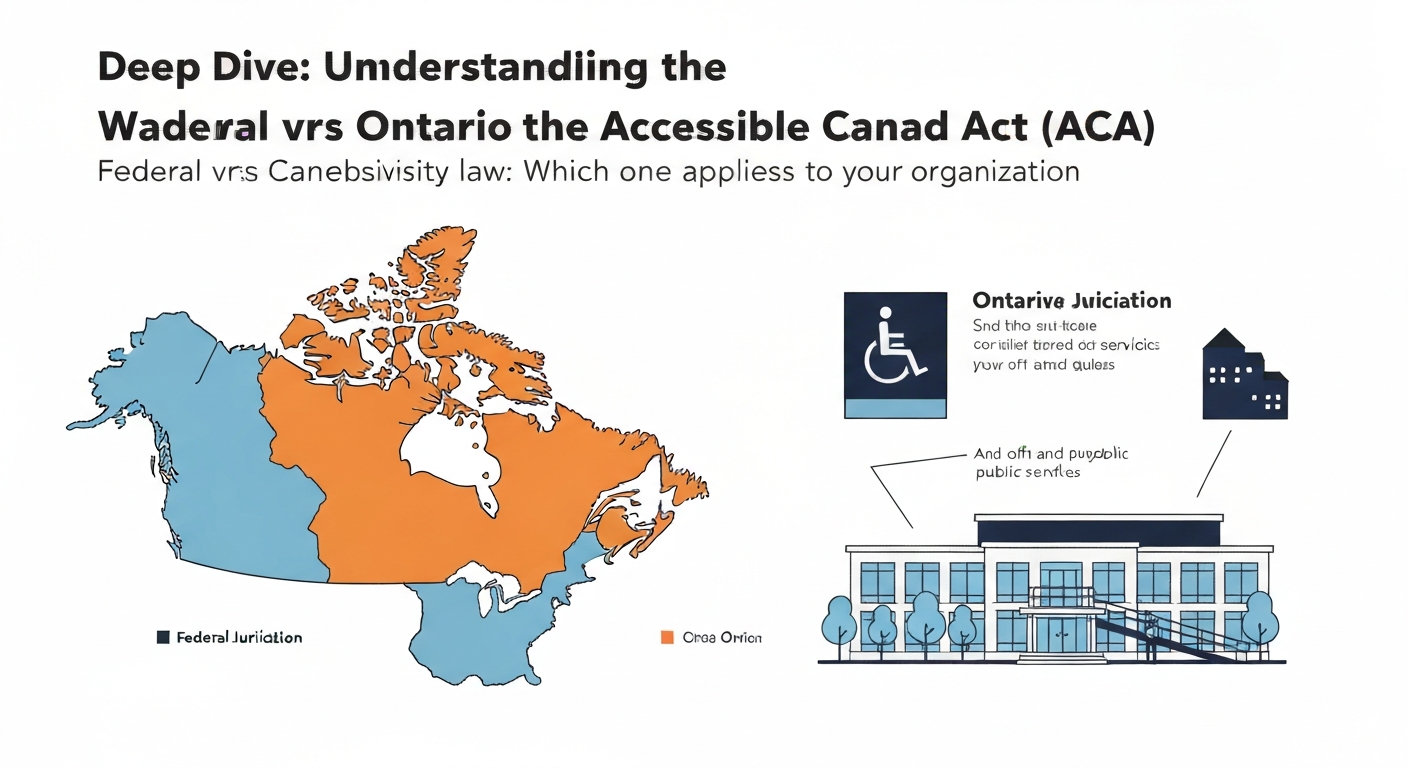
The Accessible Canada Act sets clear requirements across several key areas for federally regulated entities. Here is a snapshot of core obligations:
| Requirement | Description | Target Area Example |
|---|---|---|
| Accessibility Plans | Publish and regularly update plans detailing barrier identification and removal. | Federal government departments (e.g., Employment and Social Development Canada) |
| Feedback Mechanisms | Establish accessible ways for people to provide input on barriers. | All federally regulated banks |
| Progress Reports | Publish annual reports on plan implementation and feedback received. | Interprovincial bus services |
| Accessibility Commissioner | Respond to recommendations and orders from the Commissioner. | Canadian Broadcasting Corporation (CBC) |
| Consultation | Meaningfully consult disabled people in developing plans and policies. | Telecommunication companies (e.g., Rogers, Telus) |
These requirements push federal entities beyond mere compliance, demanding sustained, transparent effort towards a truly inclusive environment.
Deep Dive: Understanding the Accessibility for Ontarians with Disabilities Act (AODA)
The Accessibility for Ontarians with Disabilities Act (AODA) became law in 2005, charting a path toward a barrier-free Ontario by 2025. Unlike the Accessible Canada Act, AODA applies to provincially regulated organizations operating in Ontario, encompassing most businesses, non-profits, and public sector organizations. Federal versus Ontario accessibility law: which one applies to your organization.
AODA mandates specific standards across five key areas. Organizations must meet phased-in requirements, with deadlines varying based on size and sector. For instance, large organizations (50+ employees) had to comply with the Information and Communications Standard's accessible website requirements (WCAG 2.0 Level AA) by January 1, 2021, while small organizations (1 to 49 employees) have no website requirement under section 14 of O. Reg. 191/11.
AODA compliance involves meeting specific requirements across five integrated standards, with obligations often tied to an organization's size and type.
| AODA Standard | Key Requirement Example | Who It Applies To (Example) |
|---|---|---|
| Customer Service | Develop accessibility policies and provide staff training on accessible customer service. | All organizations (public, private, non-profit) in Ontario. |
| Information & Communications | Make public websites and content WCAG 2.0 Level AA compliant. Provide accessible formats upon request. | Websites: designated public sector and large organizations (50+ employees), by 2021. Accessible formats on request: all organizations. |
| Employment | Provide accessible recruitment processes and workplace accommodations. | All organizations (public, private, non-profit) with at least one employee. |
| Transportation | Ensure accessible vehicles.
How to Determine Which Accessibility Law Applies to Your Organization: A Decision FrameworkMany organizations grapple with jurisdictional uncertainty, often assuming a single accessibility framework applies to them. However, determining Federal versus Ontario accessibility law: which one applies to your organization requires a clear decision framework, not a guess. Start by assessing your primary regulatory body. Are you a federally regulated entity, such as a national bank like RBC, an airline like Air Canada, or a telecommunications provider like Bell Canada? If so, the Accessible Canada Act (ACA) applies directly. These organizations fall under federal jurisdiction for most operational aspects. If your organization is not federally regulated, then consider your provincial context. An e-commerce business based solely in Toronto, a local charity operating within Ottawa, or a public sector body like the City of Hamilton, all fall under the Accessibility for Ontarians with Disabilities Act (AODA). Understanding this framework is the first critical step toward compliance, moving past the common confusion about whether your business is federally or provincially regulated for accessibility. This clarity helps organizations prioritize their efforts and allocate resources effectively, ensuring all applicable legal requirements are met to avoid penalties and foster inclusive environments. Navigating Dual Compliance: When Both Federal and Ontario Laws Apply Organizations sometimes assume they fall under both federal and Ontario accessibility laws. However, a national bank (federally regulated) operating branches across Ontario falls under the Accessible Canada Act (ACA), not the Accessibility for Ontarians with Disabilities Act (AODA), including for its Ontario branches and customer service. Benefits of a Unified Approach
Challenges to Navigate
When an organization's operations span both federal and provincial jurisdictions, the practical advice is to adopt the "higher standard" principle. This means that for any given accessibility requirement, such as accessible procurement or employment practices, an organization should implement the more robust or detailed provision from either law. Common Myths and Your Next Steps for Accessibility ComplianceMany organizations misunderstand their accessibility obligations, leading to compliance gaps and missed opportunities. Even after determining which accessibility law applies to your organization, be it the Accessible Canada Act (ACA), the Accessibility for Ontarians with Disabilities Act (AODA), or both, several common myths persist, hindering effective implementation. Common Accessibility Myths Debunked
Myth: "We're too small to comply."
Reality: Not true. AODA applies to organizations with just one employee in Ontario. The ACA applies to federally regulated entities of all sizes, although under the Accessible Canada Regulations businesses with an average of fewer than 10 employees are exempt from publishing accessibility plans, feedback processes and progress reports.
Myth: "It only applies to physical spaces."
Reality: Both acts are far broader. They cover employment practices, information and communications (including websites and documents), customer service, and the procurement of goods and services, not just ramps or accessible washrooms.
Myth: "Compliance is a one-time task."
Reality: Accessibility is an ongoing journey. Organizations must continuously identify, remove, and prevent new barriers as services, technologies, and environments evolve. Think of it as continuous improvement, not a checklist to complete once.
Myth: "Accessibility is only about wheelchairs."
Reality: Accessibility benefits everyone and addresses a wide range of disabilities: visual, auditory, cognitive, mental health, and physical. For example, a clear language policy helps people with cognitive disabilities and those new to Canada.
Myth: Our existing policies are good enough.
Reality: Many general policies lack the specificity required by accessibility legislation. A review against WCAG 2.1 AA for digital content or AODA's Integrated Accessibility Standards Regulation is often necessary. Once your organization has clarity on the specific legislation governing your operations, the immediate next step is to conduct an internal accessibility audit. This audit identifies existing barriers across policies and practices. The Cost of Inaction: Penalties and Reputational RisksThe Cost of Inaction: Penalties and Reputational RisksOrganizations often underestimate the financial and reputational fallout from failing to meet accessibility obligations. Non-compliance with either the Accessible Canada Act (ACA) or the Accessibility for Ontarians with Disabilities Act (AODA) is not merely a theoretical risk; it carries concrete, enforceable penalties. For instance, an organization found in serious violation of the AODA could face substantial daily fines. Individuals or unincorporated organizations face up to significant financial penalties per day for similar breaches. The Accessible Canada Act also allows significant administrative monetary penalties per violation. Beyond direct financial penalties, the damage to an organization's public image and market standing can be profound and long-lasting. Negative publicity stemming from human rights complaints can erode customer trust and alienate disabled customers and their families. Organizations failing to address the question of "Federal versus Ontario accessibility law: which one applies to your organization" risk not only legal repercussions but also significant market share and brand loyalty. Proactive compliance is a strategic imperative, demonstrating a commitment to inclusion that resonates with a growing demographic of consumers and employees.Frequently Asked QuestionsHow do I know if federal or Ontario accessibility law applies to my business?Determining jurisdiction depends on your organization's operations. Federally regulated entities, such as banks, airlines, telecommunications companies, and interprovincial transportation, fall under the Accessible Canada Act. Most other businesses, non-profits, and public sector organizations operating within Ontario's borders are subject to the Accessibility for Ontarians with Disabilities Act (AODA). Your primary business activity dictates which framework applies. What is the difference between the Accessible Canada Act and AODA?The Accessible Canada Act (ACA) is federal legislation applying to federally regulated sectors across Canada, with standards developed by Accessibility Standards Canada and enforcement led by the Accessibility Commissioner. The Accessibility for Ontarians with Disabilities Act (AODA) is Ontario provincial legislation, applying to public and private sector organizations operating within Ontario, enforced by the Accessibility Directorate of Ontario. While both aim to remove barriers for disabled people, they govern different jurisdictions and have distinct compliance requirements and reporting structures. Why is it important to determine which accessibility law applies to my organization?Identifying the correct accessibility law is crucial for legal compliance and effective planning. Each act specifies unique requirements for areas like information and communications, employment, and built environment. Misunderstanding your jurisdiction can lead to non-compliance, significant financial penalties, and a failure to create truly accessible environments for disabled employees and customers. Accurate identification ensures targeted, efficient barrier removal efforts. Can my organization be subject to both federal and Ontario accessibility laws?An organization's accessibility law depends on whether it is federally or provincially regulated. For example, a federally regulated bank with branches in Ontario follows the Accessible Canada Act, not the AODA, including for its branches and customer service in Ontario. What are the penalties for not complying with Canadian or Ontario accessibility standards?Penalties for non-compliance vary by jurisdiction and severity. Under the Accessible Canada Act, organizations can face significant administrative monetary penalties per violation. For AODA, individuals may incur significant daily fines, and corporations may incur even more substantial daily fines, for each day a contravention continues. These penalties underscore the legal and financial risks of failing to meet accessibility obligations. Keep readingAll articles → Automated Accessibility Scanners vs. Testing with Assistive Technology UsersAutomated accessibility scanners are vital for a baseline, but relying solely on them misses most WCAG issues. The key is understanding their distinct roles, not choosing one over the other for full compliance.  Switch Access, Eye Tracking and Voice Control: How Each Works and Where It FitsMany disabled people with limited mobility face barriers to computer use due to universal mouse and keyboard assumptions. Switch access, eye tracking, and voice control offer specialized pathways, enabling interaction through minimal movement or voice.  CAPTCHA and Online Verification: Accessibility Barriers and Better AlternativesWhy CAPTCHA and similar verification steps shut out disabled people, what WCAG and Canadian accessibility law require, and verification methods that work for everyone. |