

AODA Compliance Blind Spots: Overlooked Obligations for Canadian Organizations in 2026
Many Ontario organizations still overlook AODA obligations, especially for digital content and employment. On conviction, a corporation can be fined up to $100,000 for each day an offence continues.

Introduction: Navigating AODA Compliance Blind Spots in 2026
Despite Ontario's January 1, 2025, accessibility target, many Canadian organizations with operations in the province still overlook critical, ongoing AODA compliance obligations in 2026, particularly around the continuous maintenance of accessible digital content and the proactive auditing of employment accommodation processes. The common misconception is that "compliance was a one-time project," rather than an ongoing operational standard, which leaves disabled people facing persistent barriers. This oversight is not merely an inconvenience; it carries substantial risks, including significant daily penalties for corporations.
Organizations often believe their initial efforts, like making a website WCAG 2.1 AA compliant, fulfill all requirements. However, AODA extends far beyond initial implementation. For example, an organization might have updated its public-facing website but neglected its obligations under the Employment Standard or the accessibility of a newly launched online service. This creates a gap, because section 14 of O. Reg. 191/11 requires designated public sector and large organizations to keep their internet websites and web content published after January 1, 2012 conforming with WCAG 2.0 Level AA, except 1.2.4 Captions (Live) and 1.2.5 Audio Description (Prerecorded).
This guide serves as a diagnostic checklist to pinpoint these subtle, yet critical, AODA compliance obligations Canadian organizations still overlook in 2026. It moves beyond basic definitions to offer actionable strategies for auditing and closing compliance gaps, ensuring organizations can navigate ongoing requirements and move towards genuine accessibility, rather than merely avoiding penalties.
AODA's Reach: Clarifying Who Must Comply in 2026 (Beyond Ontario Borders)
Many Canadian organizations still grapple with understanding AODA's jurisdictional reach, often assuming provincial laws stop at the border or only apply to large entities. Clarifying who must comply in 2026 is critical for avoiding significant penalties for corporations.
AODA Scope: A 2026 Quick Reference
AODA applies to all public and private sector organizations operating in Ontario. The regulation applies to organizations that provide goods, services or facilities and have at least one employee in Ontario, which can include businesses headquartered in Vancouver or Calgary.
AODA governs Ontario-specific accessibility. The ACA applies to federally regulated entities like banks, interprovincial transportation, and telecommunications. Which law applies depends on whether an organization, or a part of its operations, is federally or provincially regulated.
All Ontario organizations must comply. However, deadlines and some specific requirements differ for "small" (1-49 employees) versus "large" (50+ employees) organizations. For instance, the website rule in section 14 of O. Reg. 191/11 applies only to designated public sector and large organizations, so small organizations have no website obligation under that section.
While the AODA aimed for an accessible Ontario by January 1, 2025, this does not mean obligations end. Regular reporting, maintenance of accessible practices, and proactive identification of new AODA compliance obligations Canadian organizations still overlook in 2026 are continuous.
Both sectors are covered. Ontario's designated public sector (e.g., municipalities, universities, hospitals) faces more frequent reporting and earlier deadlines.
Common Misconceptions: What Organizations *Think* They've Covered (But Haven't)
Many Ontario organizations mistakenly believe that addressing their public website makes them AODA compliant, yet this narrow focus obscures significant obligations. The Accessibility for Ontarians with Disabilities Act (AODA) encompasses five distinct standards: Customer Service, Information and Communications, Employment, Transportation, and Design of Public Spaces. Neglecting these broader areas is a common blind spot, especially regarding AODA compliance obligations Canadian organizations still overlook in 2026. For example, an accounting firm might update its client portal but overlook its obligations under the Employment Standard, such as providing accessible formats of workplace information when an employee asks.
Another frequent oversight involves employee training. Organizations often substitute general "disability awareness" for the specific requirements of the AODA Customer Service Standard training. This standard mandates explicit instruction on assistive devices, service animals, support persons, and the organization's feedback process for accessibility. Similarly, an accessibility policy is insufficient without robust implementation and regular review cycles, which many organizations treat as a one-time document rather than a living framework.
Ultimately, compliance is not a project to be completed by the January 1, 2025 deadline; it is an ongoing commitment. Many organizations also fail to provide accessible formats and communication supports for non-digital information.
Information & Communications: Overlooked Digital and Non-Digital Accessibility Gaps
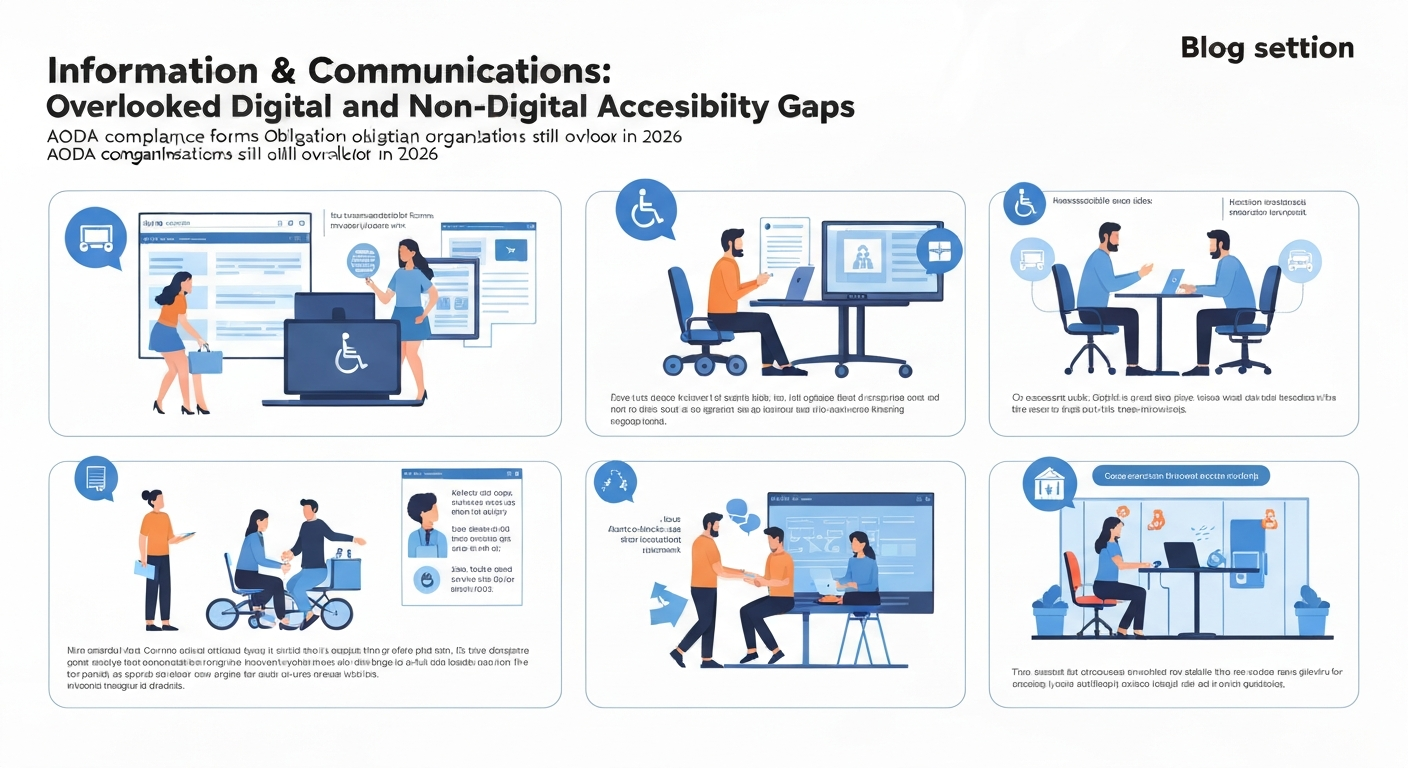
Information & Communications: Beyond Basic Digital Accessibility
Many Canadian organizations believe their AODA Information and Communications obligations end with a WCAG 2.0 AA compliant website. This overlooks critical requirements for internal documents, public feedback, and non-digital formats, creating significant AODA compliance obligations Canadian organizations still overlook in 2026. True accessibility extends far beyond a public-facing homepage.Common Misconceptions
- Focusing solely on new website content, neglecting legacy PDFs or archived video.
- Forgetting to tell the public that accessible formats and communication supports are available on request.
- Believing internal-facing documents for employees are exempt from accessibility standards.
- Having a feedback process that is not accessible through accessible formats and communication supports on request.
Overlooked Requirements
- Accessible Formats: All public documents (e.g., invoices, annual reports from a Toronto-based non-profit) must be available in accessible formats (braille, large print, audio) upon request.
- Internal Communications: When an employee with a disability asks, employers must provide or arrange accessible formats and communication supports for information needed to do the job and information generally available in the workplace, such as handbooks and training materials.
- Feedback Mechanisms: Organizations must make their feedback processes accessible by providing accessible formats and communication supports on request, and tell the public these are available.
- Communication Supports: When a disabled person asks, organizations must provide or arrange communication supports, such as sign language interpreters or real-time captioning, in a timely manner and at no more than the regular cost charged to others. A municipal council, for instance, should be ready to arrange these when asked.
Employment Standards: Beyond Basic Accommodations, Subtle Compliance Failures
Many Canadian organizations believe they meet AODA Employment Standards by offering basic accommodations, yet they often miss subtle, ongoing obligations. True compliance extends past initial requests, embedding accessibility into the entire employee lifecycle. Overlooking these nuanced requirements constitutes significant AODA compliance obligations Canadian organizations still overlook in 2026.
The Employment Standard mandates more than reactive accommodation. Employers must tell employees and the public that accommodation is available for applicants with disabilities, tell applicants selected for an assessment or interview that accommodation is available on request, and, unless they are small organizations, have a written process for documented individual accommodation plans that sets out how often plans are reviewed. Performance management and career development must take into account the accessibility needs of employees with disabilities, and employers must provide individualized workplace emergency response information where a disability makes it necessary. This information must be reviewed when the employee moves to a different location, when their overall accommodation needs or plans are reviewed, and when the employer reviews its general emergency response policies.
Return-to-work processes for employees absent due to disability represent another often-missed area. Employers other than small organizations must develop and document a return to work process for employees who were absent because of a disability and need disability-related accommodations to return.
Design of Public Spaces: Ongoing Maintenance and Unforeseen Obligations
Many organizations wrongly assume AODA Design of Public Spaces compliance is a one-time build, overlooking critical ongoing maintenance and unforeseen obligations. This static view ignores the dynamic nature of accessible infrastructure, leading to some of the most persistent AODA compliance obligations Canadian organizations still overlook in 2026.
Design of Public Spaces: Ongoing Compliance Checklist
Regularly inspect and repair accessible elements like automatic door openers, ramps, and accessible washroom fixtures. A broken button on an automatic door at a Toronto community centre renders the door inaccessible, nullifying initial compliance.
Ensure pedestrian routes remain free from obstructions, especially during seasonal changes or facility renovations. Construction hoarding blocking a tactile walking surface in an Ottawa municipal building creates immediate barriers.
When constructing or redeveloping public spaces the standard covers, such as outdoor public use eating areas and recreational trails, apply its requirements.
Integrate accessibility from the earliest design phase for new constructions or renovations, rather than retrofitting. A new wing at a Kingston hospital must incorporate accessible washrooms and clear wayfinding from blueprint stages.
Maintain clear, high-contrast, and tactile signage in public spaces.
The spirit of the Design of Public Spaces standard extends beyond initial construction. It demands vigilance, requiring facility managers, project leads, and maintenance staff to conduct regular audits and adapt to changes, ensuring public spaces remain genuinely usable for all disabled people.
Customer Service Standard: Ensuring Continuous Training and Feedback Mechanisms
Customer Service Standard: Continuous Training and Feedback
Many organizations in Ontario mistakenly believe a one-time training session satisfies their AODA Customer Service Standard obligations, yet continuous reinforcement and accessible feedback loops are critical and frequently overlooked. The standard requires training for employees, volunteers, people who develop the organization's policies and anyone who provides goods, services or facilities on its behalf, as soon as practicable, and further training whenever the customer service policies change.
For instance, a retail chain must make sure seasonal hires and delivery staff who serve customers on its behalf receive the same training on interacting with people who use service animals and support persons as its full-time store staff. This goes beyond basic onboarding.
Another common oversight involves feedback processes. Organizations often fail to clearly communicate and actively solicit accessible feedback from customers with disabilities. The feedback process must be accessible through accessible formats and communication supports on request, must say what the organization will do when it receives a complaint, and information about it must be readily available to the public. Similarly, when facilities or services that disabled people usually rely on, such as an elevator, are temporarily disrupted, the organization must give public notice that includes the reason, the expected duration and any alternatives, for example by posting it on the premises or on its website. Regularly reviewing and updating customer service policies helps them reflect good practice and the needs of disabled people, ensuring these AODA compliance obligations Canadian organizations still overlook in 2026 are addressed proactively.
Proactive Audit: A 2026 Checklist for Identifying and Rectifying Hidden Compliance Gaps
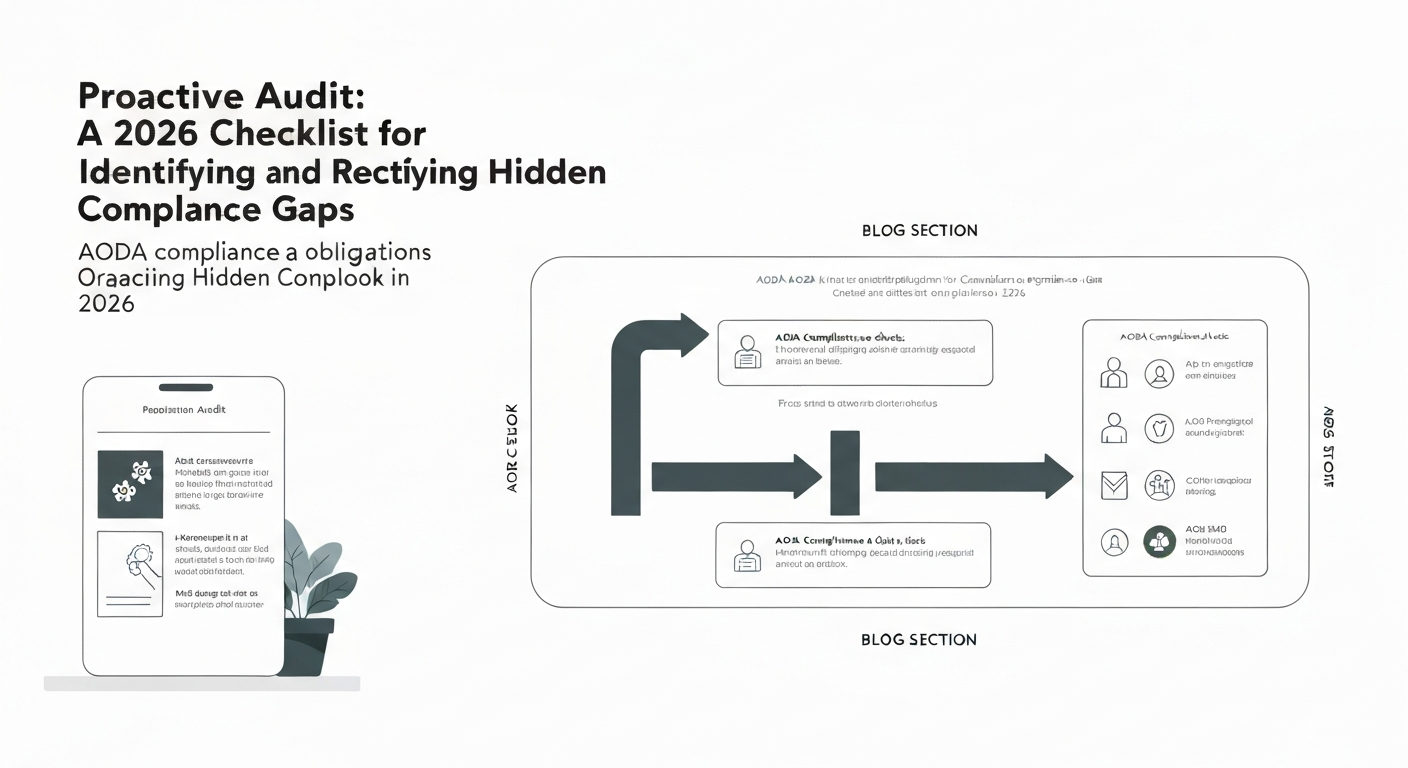
Identifying hidden compliance gaps requires a systematic approach. Many Canadian organizations still overlook subtle AODA compliance obligations in 2026, often due to an incomplete understanding of their specific requirements, especially beyond initial deadlines. A proactive audit can uncover these blind spots before they lead to penalties.
Audit All Five Standards
Conduct a comprehensive internal audit across all AODA standards: Customer Service, Information and Communications, Employment, Transportation (if applicable), and Design of Public Spaces. For instance, a mid-sized Ontario accounting firm must review its digital document accessibility under Information and Communications, not just its public-facing website.
Engage Disabled Employees & Experts
Solicit feedback from employees with disabilities and engage external accessibility consultants. A senior manager at a Toronto-based tech company might identify overlooked barriers in their internal software interfaces that formal audits miss. Their lived experience offers invaluable insight into real-world usability.
Prioritize Gaps by Impact
Rank identified gaps based on the risk of non-compliance and potential impact on individuals. Under section 37 of the AODA, a corporation convicted of an offence can be fined up to $100,000 for each day the offence continues. Prioritize rectifying issues that affect core services or pose significant legal exposure.
Develop an Action Plan
Create a clear action plan for closing each gap.
Reporting and Documentation: Avoiding Administrative Oversights and Penalties
Reporting and Documentation: Avoiding Administrative Oversights and Penalties
Organizations often focus on implementing accessibility measures, yet routinely underestimate the administrative burden of proving that work. Failing to properly document and report accessibility efforts is a critical area where AODA compliance obligations Canadian organizations still overlook in 2026. Failing to file a required report can lead to a compliance order and an administrative penalty, and under section 37 of the AODA a director or officer who fails to take reasonable care to prevent a corporate offence can be fined up to $50,000 per day on conviction. For instance, a company might diligently train staff on accessible customer service, but if a required accessibility compliance report was never filed, it remains non-compliant. The specific reporting deadlines vary significantly. Designated public sector organizations must file accessibility compliance reports every two years, and large organizations (50+ employees) every three years. Small organizations with 20 to 49 employees file every three years on the Customer Service Standard only, and organizations with fewer than 20 employees do not file, but all must still meet the requirements that apply to them. Designated public sector and large organizations must keep records of the accessibility training they provide, including dates and the number of people trained. Keeping records of feedback received from disabled people, actions taken to address identified barriers, and reviews of accessibility policies is also good practice. Without these records, proving compliance during an audit becomes nearly impossible. Proactive communication of these efforts, both internally and externally, fosters transparency and accountability, moving beyond mere compliance to genuine organizational commitment. This administrative diligence forms the backbone for addressing other subtle compliance failures, particularly within information and communications.AODA Compliance Blind Spots: A 2026 Diagnostic Summary
Even as most AODA deadlines pass, organizations frequently miss ongoing compliance requirements, leading to persistent risk. This diagnostic table highlights key AODA compliance obligations Canadian organizations still overlook in 2026, offering actionable steps for rectification.
| Overlooked Area | AODA Standard(s) | Primary Risk in 2026 | Critical Action for Organizations |
|---|---|---|---|
| Digital Procurement Criteria | Information & Communications | Acquiring inaccessible software or platforms, creating new barriers for disabled employees or customers. | Integrate WCAG 2.1 AA requirements into all IT procurement contracts, especially for SaaS tools. |
| Emergency Procedure Accessibility | Employment, Customer Service, Design of Public Spaces | Failure to provide accessible emergency information or evacuation plans for all disabled people on premises. | Review and update emergency plans with disabled employees, ensuring diverse formats and assistance protocols. |
| Ongoing Training Refreshers | Customer Service, Information & Communications | Staff attrition or knowledge fade, leading to inconsistent accessible customer service or content creation. | Mandate annual refresher training for all staff on accessibility principles and specific AODA requirements. |
| Feedback Loop Integration | Customer Service, Information & Communications | Lack of accessible, monitored channels for disabled people to report barriers, delaying issue resolution. | Establish and widely publicize multiple accessible feedback mechanisms (e.g., email, TTY, accessible web form) and assign clear response protocols. |
Proactive engagement with these areas moves beyond basic compliance, ensuring an inclusive environment. Ignoring these points can lead to penalties, including fines on conviction of up to $100,000 per day for corporations under section 37 of the AODA.
Verdict: Your Path to Comprehensive AODA Compliance in 2026
Achieving comprehensive AODA compliance in 2026 demands more than surface-level adherence; it requires embedding accessibility deep into an organization's operational DNA. Many Canadian organizations, particularly those operating across provincial lines, still struggle to differentiate between AODA requirements for Ontario-based operations and the broader Accessible Canada Act. This confusion often leads to overlooking specific AODA obligations, especially in areas like the ongoing maintenance of public spaces or the nuances of the Employment Standard.
For organizations concerned about penalties, which can reach $100,000 per day for corporations on conviction under section 37 of the AODA, proactive internal audits are indispensable. These audits go beyond basic website checks, scrutinizing everything from procurement processes for accessible information and communication technologies to the continuous training of staff on the Customer Service Standard.
The key to identifying and rectifying the AODA compliance obligations Canadian organizations still overlook in 2026 lies in continuous vigilance. Organizations must move past viewing AODA as a one-time compliance hurdle and embrace it as an ongoing commitment. This shift makes accessibility an integral part of business strategy, which benefits disabled customers and employees.
Moving forward, organizations must integrate these insights into their strategic planning to not only meet their legal obligations but also to enhance their reputation as inclusive employers and service providers. The next steps involve translating these diagnostic observations into action.
Frequently Asked Questions
Is AODA compliance required for Canadian companies outside Ontario in 2026?
What AODA digital accessibility mistakes do Canadian businesses still make in 2026?
How can Canadian organizations identify subtle AODA employment compliance failures in 2026?
Why is AODA reporting and documentation often overlooked by Canadian organizations in 2026?
Can a 2026 AODA compliance audit reveal hidden customer service gaps for Canadian businesses?
Keep reading
All articles →
Automated Accessibility Scanners vs. Testing with Assistive Technology Users
Automated accessibility scanners are vital for a baseline, but relying solely on them misses most WCAG issues. The key is understanding their distinct roles, not choosing one over the other for full compliance.

Switch Access, Eye Tracking and Voice Control: How Each Works and Where It Fits
Many disabled people with limited mobility face barriers to computer use due to universal mouse and keyboard assumptions. Switch access, eye tracking, and voice control offer specialized pathways, enabling interaction through minimal movement or voice.

CAPTCHA and Online Verification: Accessibility Barriers and Better Alternatives
Why CAPTCHA and similar verification steps shut out disabled people, what WCAG and Canadian accessibility law require, and verification methods that work for everyone.